Introduction to TIG / Argon Welding
TIG welding, also known as Tungsten Inert Gas (GTAW), is a high-precision welding process widely used in industrial and professional applications. This method uses a non-consumable tungsten electrode along with an inert gas (typically argon) to produce clean, strong, and high-quality welds.
Unlike other welding processes, TIG welding allows better control over heat and weld quality, making it ideal for delicate and high-value materials.
How TIG Welding Works
In TIG welding:
- A non-consumable tungsten electrode creates the arc
- Heat is generated between the electrode and the workpiece
- An inert shielding gas protects the weld area from contamination
- Optional filler rod is used to strengthen the joint
This process ensures precise, clean, and spatter-free welding results.
TIG Welding Power Supply Types
1. Direct Current (DC)
- Used for steel, stainless steel, copper, and titanium
- Provides deep penetration and stable arc
- Most commonly used TIG welding mode
2. Alternating Current (AC)
- Used for aluminium and magnesium
- Helps remove oxide layers from metal surface
- Ensures strong and clean welds
3. Pulsed Current TIG
- Controls heat input effectively
- Ideal for thin materials
- Reduces distortion and improves weld appearance
Telwin TIG Welding Machines – Single Phase Supply
ADVANCE TIG 227 MV/PFC DC-LIFT VRD
- Wide input voltage range (100–240V)
- Stable performance even with power fluctuations
- VRD safety system for operator protection
- Suitable for harsh environments like shipyards and mines
- Supports steel, stainless steel, titanium, copper, and nickel
FORCE TIG 170 DC-LIFT 230V
- Compact and lightweight design
- Easy current control with display
- Supports multiple electrode types
- Ideal for workshop and light industrial use
TECHNOLOGY TIG 222 AC/DC-HF/LIFT 230V
- Advanced microprocessor control
- Supports AC/DC TIG, Pulse TIG, and MMA
- Suitable for aluminium, stainless steel, and alloys
- Features include post gas control, slope adjustment, and balance control
TECHNOLOGY TIG 182 AC/DC-HF/LIFT 230V
- Multi-process capability (TIG + MMA)
- High-frequency and LIFT arc start
- Stable performance for professional welding tasks
- Delivered with complete TIG accessories
Telwin TIG Welding Machines – Three Phase Supply
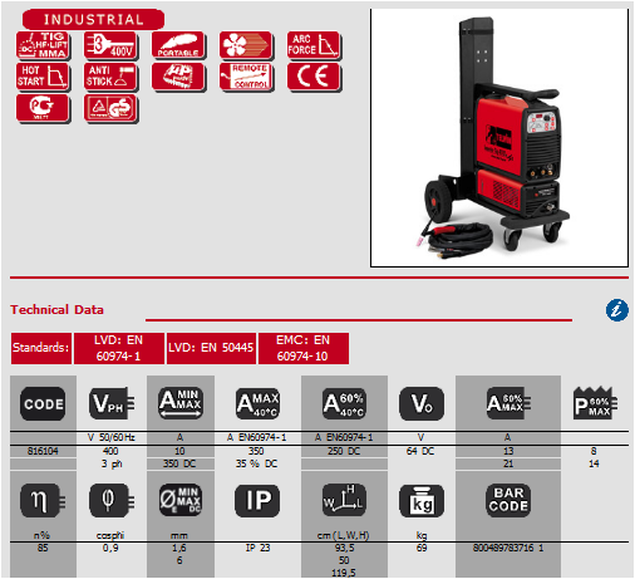
SUPERIOR TIG 421 DC-HF/LIFT 400V
- Industrial-grade TIG welding machine
- Pulse and EASY pulse operation
- Stores customized welding programs
- Water cooling system for heavy-duty use
- Ideal for continuous industrial welding operations
TIG Welding Circuit Components
A complete TIG welding setup includes:
- Power source (AC or DC)
- Tungsten electrode torch
- Shielding gas cylinder (Argon/Helium)
- Welding rod (optional)
- Ground clamp and cable
- Water cooling unit (for high current)
Each component plays a critical role in achieving high-quality weld results.
Shielding Gases in TIG Welding
Argon (Ar)
- Most commonly used gas
- Stable arc and clean weld
- Ideal for thin materials
Helium (He)
- Higher heat input
- Suitable for thick materials
- More expensive than argon
Argon-Helium Mixtures
- Balanced performance
- Improved penetration and speed
Types of Tungsten Electrodes
- Pure Tungsten: Suitable for AC welding
- Thoriated Tungsten: Stable arc, ideal for DC welding
- Zirconiated Tungsten: Best for aluminium welding
- Ceriated Tungsten: Good performance and durability
Arc Starting Methods
HF (High Frequency) Start
- Contactless arc starting
- Clean and professional weld start
LIFT Start
- Low interference method
- Suitable for sensitive environments
Scratch Start
- Basic method but lower weld quality
- Can contaminate weld
Materials Suitable for TIG Welding
Stainless Steel
- High-quality, clean welds
- Requires DC welding
- Ideal for precision work
Aluminium & Alloys
- Requires AC welding
- Needs proper oxide cleaning
- Used in automotive and aerospace
Other Materials
- Copper and alloys
- Nickel and titanium
- Mild steel and special metals
Advantages of TIG Welding
- Extremely high weld quality
- Clean and spatter-free results
- Precise control over welding process
- Suitable for thin and delicate materials
- Works on a wide range of metals
Conclusion
TIG welding (GTAW) is one of the most advanced and precise welding techniques available today. With superior control, clean weld output, and versatility across materials, it is the preferred choice for industries requiring high-quality finishing.
Telwin TIG welding machines offer reliable, efficient, and industrial-grade solutions for both single-phase and three-phase applications, ensuring consistent performance in every welding task.
If you’re looking for precision, durability, and professional results — TIG welding is the ideal solution.