Introduction to MIG/MAG Welding (GMAW)
MIG/MAG Welding, also known as Gas Metal Arc Welding (GMAW), is one of the most advanced and widely used welding processes in modern industrial applications. This method uses a continuous wire electrode and an electric arc to join metals efficiently with high precision and speed.
Depending on the setup, GMAW can be performed:
- With gas shielding (MIG/MAG)
- Without gas shielding using flux-cored or self-shielded wire
This flexibility makes MIG/MAG welding suitable for a wide range of materials and environments.
How MIG/MAG Welding Works
In MIG/MAG welding:
- A continuous wire electrode is fed through a welding torch
- An electric arc forms between the wire and the workpiece
- The wire melts and forms the weld joint
- Shielding gas (or flux) protects the weld from contamination
Two Main Welding Methods:
1. Gas Shielded Welding (MIG/MAG)
- Uses external gas (Argon, CO₂, or mixtures)
- Provides clean, high-quality welds
- Ideal for industrial and precision work
2. Flux-Cored / Self-Shielded Welding
- No external gas required
- Uses tubular wire with internal flux
- Suitable for outdoor and heavy-duty applications
Shielding Gases in MIG/MAG Welding
Shielding gas plays a critical role in weld quality and arc stability.
Inert Gases
- Argon (Ar): Stable arc, smooth weld, widely used
- Helium (He): Deep penetration, suitable for thick materials
Active Gases
- Carbon Dioxide (CO₂): Strong penetration, cost-effective
Gas Mixtures
- Argon + CO₂
- Argon + Oxygen
- Argon + Helium
These mixtures improve arc stability, metal transfer, and overall weld quality.
Types of Welding Wires
1. Solid Wire
- Smooth feeding
- Clean weld results
- Common diameters: 0.6 – 1.6 mm
2. Flux-Cored (Tubular) Wire
- Contains internal flux
- Better penetration and arc stability
- Suitable for heavy-duty applications
- Requires slag removal
Proper wire handling is essential to avoid defects like porosity and unstable arcs.
Metal Transfer Methods in GMAW
1. Short Circuit (Short Arc)
- Low current (up to 200A)
- Suitable for thin materials
- Works in all positions
2. Spray Transfer
- High current (>200A)
- Deep penetration
- Best for thick materials and flat positions
3. Pulsed Arc Transfer
- Controlled droplet transfer
- High-quality welds
- Ideal for aluminium and stainless steel
Materials Suitable for MIG/MAG Welding
Carbon Steel
- Uses CO₂ or Argon-CO₂ mixtures
- Strong and reliable welds
- Suitable for all positions
Stainless Steel
- Requires Argon-based mixtures (≥98% Argon)
- Prevents oxidation and ensures clean welds
Aluminium & Alloys
- Uses Argon or Argon-Helium
- Requires spray or pulsed arc technique
- Ideal for lightweight structures
Other Materials
- Copper, nickel, and alloys
- Requires parameter adjustments based on thickness
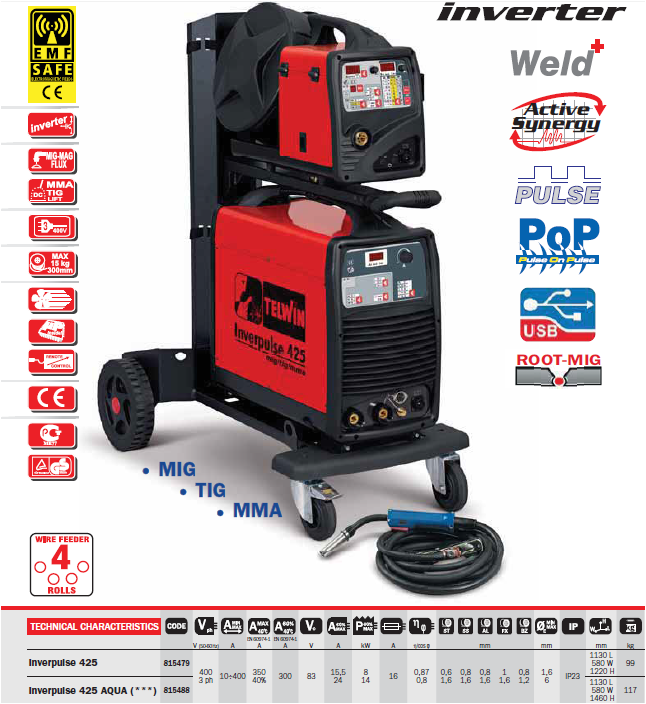
Telwin MIG/MAG Welding Machines – Advanced Industrial Solutions
Telwin offers a wide range of inverter-based MIG/MAG welding machines designed for both single-phase and three-phase operations.
Key Features:
- Synergic Control System: Automatic parameter adjustment
- Pulse & Double Pulse Technology: Improved weld quality
- Multi-process Capability: MIG/MAG, FLUX, TIG, MMA
- Programmable Settings: Save custom welding programs
- Advanced Protection Systems: Voltage and thermal protection
- Industrial Integration: Compatible with automation and robotic systems
Popular Models:
- TECHNOMIG Series (200 / 225 Pulse)
- INVERPULSE Series (320 / 425 / 625)
These machines deliver high precision, efficiency, and flexibility for demanding industrial environments.
Advantages of MIG/MAG Welding
- High welding speed and productivity
- Clean and strong welds
- Suitable for automation and robotics
- Minimal post-weld cleaning
- Versatile across multiple materials
Conclusion
MIG/MAG (GMAW) welding is a highly efficient and versatile welding solution suitable for both light and heavy industrial applications. With options for gas-shielded and flux-cored welding, it provides flexibility for different environments and materials.
Modern inverter technology and synergic control systems, such as those offered by Telwin, ensure superior performance, precision, and ease of use.
For industries seeking reliable, high-quality welding solutions, MIG/MAG welding remains a top choice worldwide.